
Hi darling, hope you're doing amazing. I started writing this from row 22C, omw to London for some interesting events and meetings, and finished writing on my return flight. I was so excited, because one of the objectives of the trip was to network (that sounds lame, I'd rather say make friends).
It's been a caviar-heavy week. I got to talk to some very interesting people, and I came back with one lesson that kept repeating itself in room after room.
You must be obsessed with what you do.
WxH moodboard

Wealth: Does Bond girl summer mean alternatives autumn?
A few issues ago, I wrote about bond girl summer, and bond yields are near an 18-month high, which usually signals public markets are due for a correction. A good place to sit out that scenario might be alternative assets. Not because they don't fall, but because nobody's sending you a push notification when they do, so at least your nervous system is intact. My POV: Alternative assets are the asset class women dominate.
Alternatives are everything that isn't a classic financial asset (public stocks, bonds, cash), commonly real estate, art, purses, watches, angel investments, and more.
They are often illiquid, meaning they move slowly, which implies that if you invest in alternatives, you're in it for the long run. If you are patient, calculated, and attentive to detail, not just numbers, this is a great asset class for you. Large parts of my portfolio are in real assets, and for my risk profile it's the most comfortable strategy.
Say you angel in a multifunctional smoothie boutique. You wouldn't just look at the numbers, the most important metrics for the business's success are likely non-numerical: Is it in a location your health-conscious target audience actually frequents? Are the aesthetics compatible with the vision, or can they become compatible, and at what effort/price? Are the surrounding businesses complementary? Do people walk by? Can they drive there? How will the cultural fabric of the area develop over the next few years, and can you predict some of it before you buy? Is the health stack beneficial, how do people feel after consuming it?
And many, many more that will give you better metrics for probability of success than pure numbers. The closer you are to the product or service, the better your judgement, and the better your investment. The same reasoning applies across alternative investments like real estate, art, watches and so on. From a financial perspective, my personal favorite is real estate, but watches and angel investing have my heart.

Business: Let's talk events
I love a good event, and apparently everyone does rn; Allied Market Research has the industry going from roughly $737 billion in 2021 to $2.5 trillion by 2035. As human connection is getting increasingly valuable in an agentic world, my forecast is that in-person experiences will get way more attention going forward. The move from digital to physical will show up in the details: a curated space or a handwritten note will read as luxury, because it signals a human actually spent time on it.
The rise of in-person everything also means social skills are key. I've seen the "party girl" reference all over my feed and I LOVE it. Party girls are essentially super connectors, the kind of girls who know, or at least know of, everyone in a space, and who should meet who.
Your introductions are a currency
Just because you can make an intro doesn't mean you should, every one of them reflects back on you. Between peers, the risks are lower, but when there's some sort of a power imbalance, I try to be extra careful and ask myself: would both sides want this even if I weren't in the middle? If you happen to know someone many people want access to, handing out that intro to every interested person probably isn’t the right move.
Access behaves like any currency, print too much of it and it stops being worth anything.
Health: Froyo but make it functional
The category I've been quietly obsessed with all summer, multifunctional foods are it right now. I went to Stockholm not too long ago, and cooled down with a protein soft serve, essentially an ice cream with 100 kcal and 15g of protein. For a conscious consumer like myself, the value is unmatched: the satisfaction of a real ice cream with the benefits of a protein shake. It's no coincidence this lands mid-GLP-1 boom: high-protein everything is the moment.
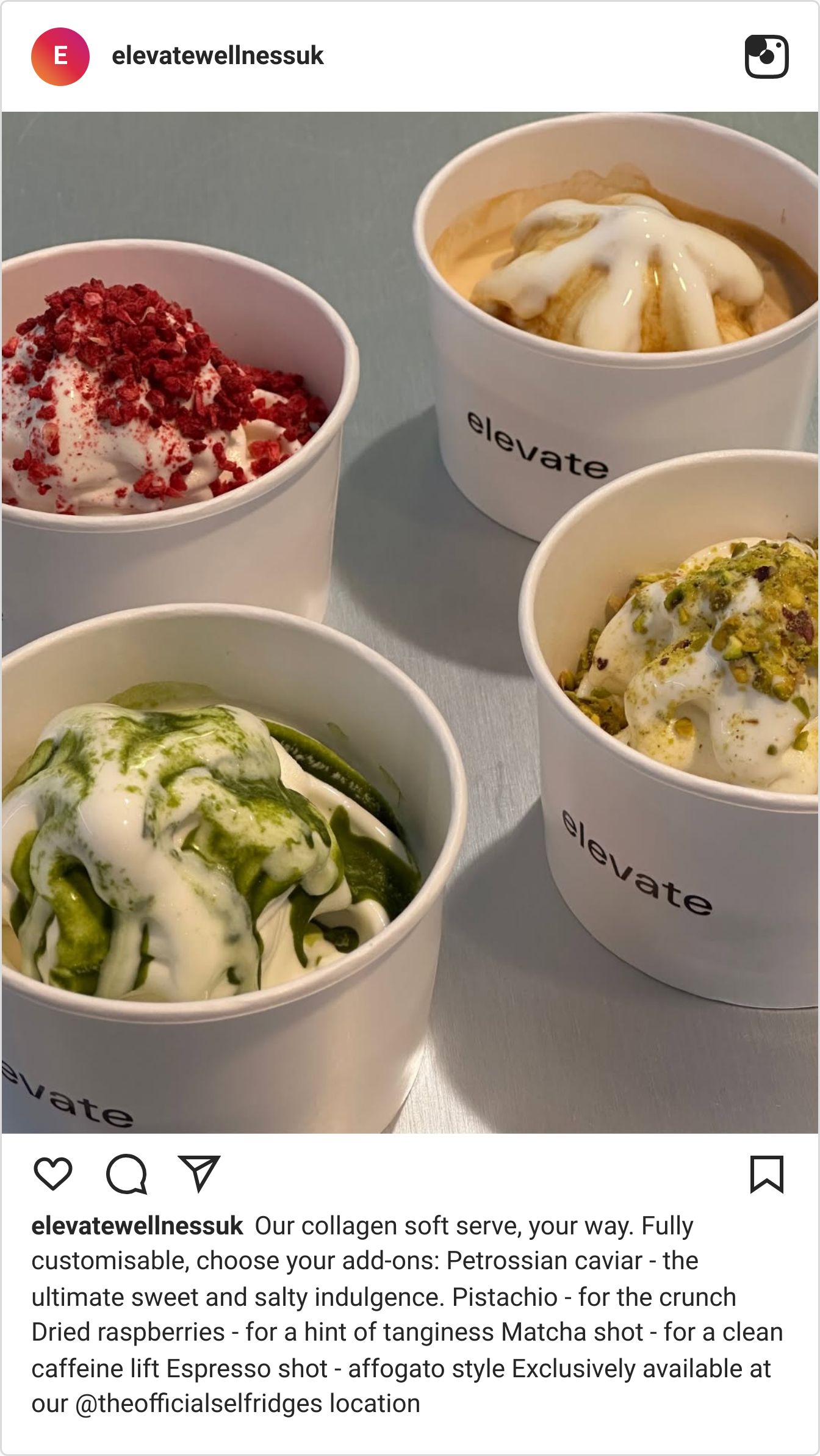
And I'm clearly not the only one. In London, Elevate is serving collagen soft serve alongside smoothies boosted with hyaluronic acid and adaptogens. It's female-founded and raised a £400k pre-seed (it's inside Selfridges). There is Mimi’s, Myka and many others selling gut health with luxe vibes: probiotic-rich, cultured-milk soft serves topped with fresh honeycomb. The WSJ just covered the froyo boom in New York, and the same shift is happening on this side of the Atlantic: roughly 1 in 3 European consumers bought dairy with a protein claim in the past year, and the numbers skew heavily toward Gen Z and millennials.
This happens at the same time we are trading happy hour for wellness, and the money that used to go to cocktails now goes to treats that work for you.
Which brings me back to my London trip. In every room, the people doing the most interesting things were a little unreasonable, and honestly the froyo founders are no different, someone cared enough about functional foods to put collagen in soft serve and get it into Selfridges. That's the same edge I was describing with alternatives. You don't win by reading the numbers better, you win by being the most obsessed with what you do.
Thanks for reading, until next time loves!
Big hugs